
- First-time clients
- Expect a 50% deposit before filming, 50% on delivery
- Longest reasonable payment term
- Net 30, and that's the ceiling, not the standard
- Net 60 and Net 90
- No longer appropriate for creative services
- Why the deposit exists
- It funds the crew and gear that make your project happen
- Online payment
- Expect to cover credit card and ACH processing fees
- Paying by check
- Still the cheapest way to pay a large invoice, with no processing fees
Here's a question that almost never comes up until the invoice arrives: when, exactly, are you supposed to pay a video production company? Most businesses default to whatever their accounts payable department always does, whether that's Net 30, Net 60, or sometimes Net 90, and assume creative vendors fit the same mold as office supplies and software licenses. They don't. This guide explains how video production payment actually works, why the deposit structure exists, and why the slow-payment terms that made sense for commodity vendors are the wrong fit for creative service providers. The goal here isn't to argue for the production company's side. It's to explain a system that protects both sides.
In this guide
- Why creative services aren't Net 30 vendors
- The deposit structure for first-time clients
- How terms change once you've built a relationship
- Why the deposit actually matters (it's about people, not paperwork)
- How to pay: online, ACH, and the case for checks
- What healthy payment terms protect you from
- Frequently asked questions
Why creative services aren't Net 30 vendors
Net 30, meaning payment of an invoice within 30 days of receiving it, exists for a reason. It made sense in a world of recurring commodity purchases: you buy paper from the same supplier every month, you reconcile invoices in batches, and the supplier extends you credit because the relationship is ongoing and the amounts are predictable. Net 30 is a system for managing volume between businesses that transact constantly.
That's not what a video production project is. A video project is a one-time (or occasional) engagement with a defined start and finish, performed by a small team, often involving real out-of-pocket costs that happen before you ever see the finished product.
Here's the test that makes it obvious. Think about the other service providers you pay. When a plumber comes to your house and fixes a burst pipe, you don't tell them you'll pay in 30 days. You pay them when the work is done, that day, on the spot. The same is true for most services you hire directly:
- An electrician rewires your panel and invoices you on completion. You pay promptly.
- A landscaper finishes a job and expects payment that week, not next month.
- A mechanic doesn't release your car until you've paid for the repair.
- A caterer requires a deposit to book the date and the balance around the event.
- A contractor works on a deposit-and-milestone schedule, not Net 60.
Nobody thinks these expectations are unreasonable. They reflect a basic truth: when a small business performs a defined service for you, payment happens close to when the work happens.
Somewhere along the way, creative services got mentally filed in the wrong cabinet. Because video production, photography, graphic design, and marketing are often billed to a marketing department, and marketing departments deal with media buys, agencies, and software subscriptions on Net 30 and longer terms, creative vendors got swept into the same payment system. But a freelance videographer or a small production company has far more in common with the plumber than with your software provider. They're a small operation doing defined, hands-on work with real upfront costs. They should be paid like one.
This isn't about creative people being special or precious. It's the opposite. It's about recognizing that creative services are services, just like the trades, and the people performing them deserve the same prompt payment any other service provider gets.
The deposit structure for first-time clients
For a first project with a new production company, the standard structure is straightforward:
50% deposit before filming. 50% on delivery.
Some companies split it into thirds (a third to book, a third at the shoot, a third on delivery), but the 50/50 model is the most common and the easiest to understand. Here's what each half covers:
The deposit (paid before the shoot) confirms the booking, reserves the dates on the calendar, and, critically, funds the actual costs of producing your video. More on that below, because it's the part most clients don't think about.
The balance (paid on delivery) is due when the finished video is delivered to you, or within a short window afterward, not 30, 60, or 90 days later. "On delivery" can reasonably mean "within a week of delivery" to give your accounting team time to process it, but it shouldn't stretch into next quarter.
If a production company asks for a deposit before starting work, that is not a red flag. It's the norm. The red flag would be a company willing to do thousands of dollars of work with no deposit at all, which often signals either desperation or inexperience.
How terms change once you've built a relationship
The 50% deposit rule is a first-time standard, not a permanent one. Once you and a production company have worked together successfully, meaning they've delivered good work and you've paid promptly, terms naturally relax. Trust gets built, and the structure can flex.
For established, repeat clients, it's common and reasonable to:
- Drop the deposit entirely for routine projects and move to a single invoice on delivery
- Shift to a smaller deposit (say, 25%) instead of the full half
- Set up a simple Net 15 or Net 30 on delivery for ongoing relationships
There's one important exception, and that's the size of the invoice. Even with a trusted, long-term client, a production company will usually still ask for a deposit on a large project, say a multi-day shoot or a five-figure campaign. That's not a trust issue. It's a cash flow reality. A $25,000 production involves real money going out the door for crew, equipment rental, location fees, and insurance, well before the final video is delivered. No small business can float that kind of expense on behalf of a client, no matter how good the relationship is.
So the rule of thumb is this: trust reduces the deposit on routine work, but larger projects still warrant a deposit regardless of how long you've worked together.
Get a real scope and budget in 24 hours.
Tell us about your goals and we'll come back with a recommended format, a realistic timeline, and a written proposal.
Request a Proposal →Why the deposit actually matters (it's about people, not paperwork)
This is the part worth understanding, because it reframes the whole conversation. When most clients think about a deposit, they think of it as the vendor "protecting themselves" or "making sure they get paid." That's part of it, but it misses the more important point.
The deposit is what pays the people who work on your project.
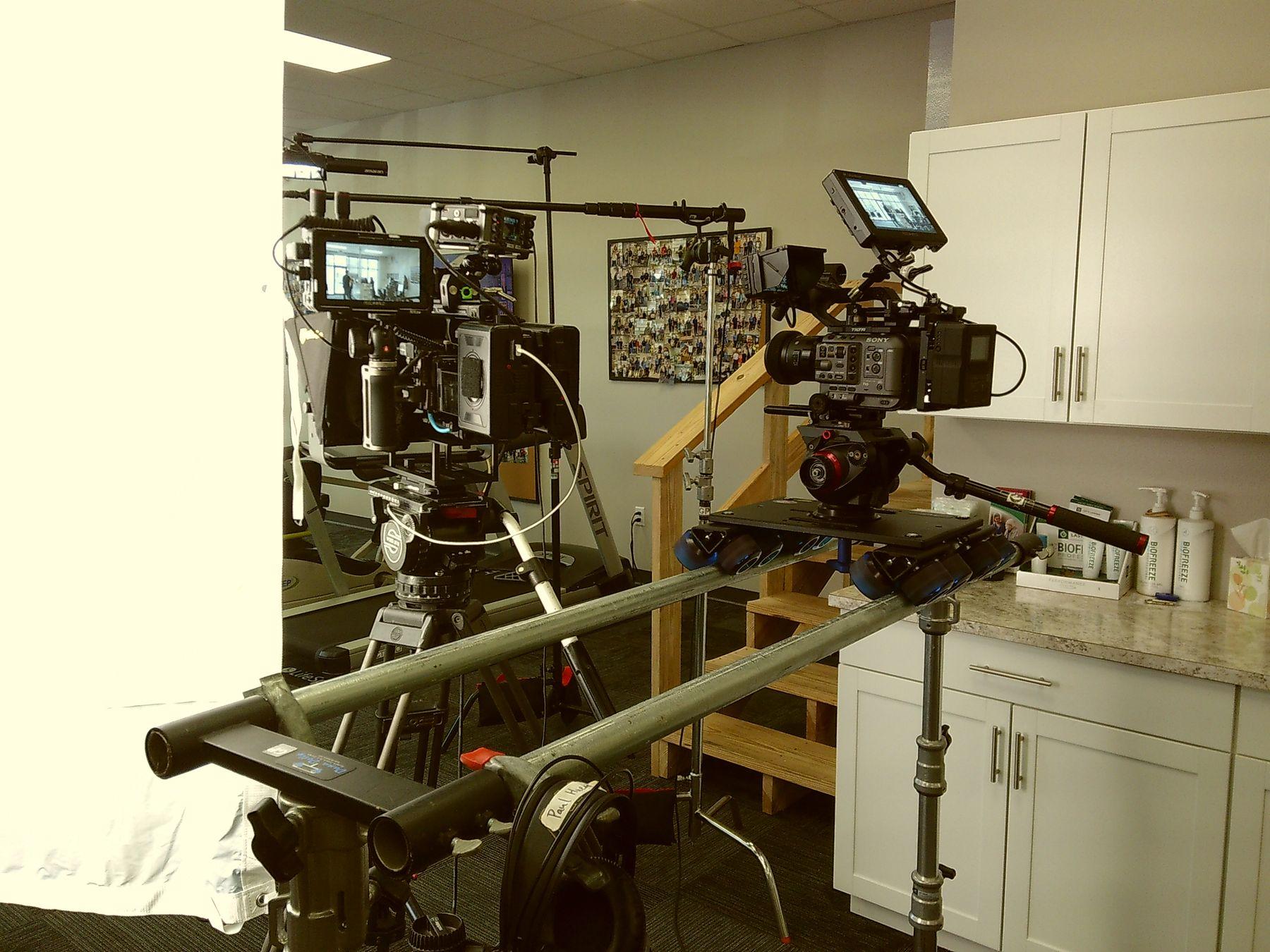
A video shoot isn't one person. A typical production day involves a camera operator, possibly a second shooter, an audio technician, a lighting assistant, maybe a production assistant or a drone operator. Many of these people are contractors who worked your shoot and expect to be paid promptly afterward, often within days, not months. There's also equipment to rent, insurance to carry, location fees to pay, and other hard costs that come due right around the time of the shoot.
If a production company has to wait 60 or 90 days for you to pay, they're floating all of those costs out of their own pocket in the meantime, paying their crew, their rentals, and their overhead while waiting on your accounts payable cycle. For a small business, that's not a minor inconvenience. It's the difference between a healthy operation and one constantly scrambling to cover payroll for work it already delivered.
When you pay a deposit before the shoot and the balance promptly on delivery, you're not just settling an invoice. You're making sure the freelancers who showed up and did great work on your project get paid on time. That's a reasonable thing to want to be part of.
This is also why slow-payment terms are quietly corrosive. A company forced to wait three months for payment either has to build that delay into higher prices, take on debt to cover the gap, or eventually stop taking clients who pay slowly. None of those outcomes are good for you as the client.
How to pay: online, ACH, and the case for checks
Modern production companies should make it easy to pay, and you should expect a few options. Here's how they compare.
Credit card
The most convenient option, and increasingly common. The trade-off is credit card processing fees. Card processors charge the business roughly 2.9% plus a small per-transaction fee, and on a large invoice that adds up fast. On a $10,000 project, that's nearly $300 in fees.
Because of that, expect to cover the processing fee as a surcharge when you pay by card. This is standard practice and entirely fair. The fee is a direct cost of you choosing the convenient payment method, so it makes sense that it's added to your total rather than absorbed by the production company, which would otherwise have to raise everyone's prices to cover card fees. If paying by card is worth the convenience to you, the surcharge is the cost of that convenience.
ACH / bank transfer
A direct bank-to-bank transfer. Lower fees than credit cards, but usually not entirely free. Many payment platforms charge a smaller percentage or a flat fee for ACH. Expect a modest processing charge here too, though typically less than a card.
Paper check
Here's the one that surprises people: in the modern era, mailing a check is still one of the best ways to pay a large invoice, specifically because there are no processing fees. None. A $15,000 check costs you a stamp and costs the production company nothing to deposit.
For big invoices, that fee savings is real money. Many production companies will happily take a check for exactly this reason, and some will even offer a slightly better total for check payment since they're not losing 3% to a card processor. If you're paying a large balance and you're not in a rush, a check is often the smartest financial choice for both sides.
The takeaway: online payment for convenience, check for cost savings on large invoices. A good production company will offer both and let you choose based on what matters more to you on a given project.
What healthy payment terms protect you from
It might seem like prompt payment and deposits only benefit the production company. They don't. A clear, fair payment structure protects you as the client in several ways.
It signals a real business. A company that has a deposit policy, clear payment terms, and professional invoicing is a company that's been doing this long enough to have its house in order. The vendor who's vague about payment is often vague about everything else too.
It keeps your project a priority. A funded project with a deposit on it is a committed project. It's on the calendar, the crew is booked, and the company has skin in the game to deliver. The "we'll sort out payment later" projects are the ones that slip.
It keeps the crew that serves you healthy. As covered above, prompt payment keeps the freelancers and contractors who work on your video paid and willing to keep doing great work, including on your future projects.
It keeps prices honest. Companies that get paid promptly don't have to inflate prices to cover the cost of floating slow-paying clients. Your prompt payment is part of what keeps your rate fair.
Frequently asked questions

Get a real quote in 24 hours.
Tell us about your project and we'll send back a written proposal with scope, pricing, and clear payment terms, within one business day. No surprises.
Request a Free Quote →